Wholesale Rohde & Schwarz R&S®SMW200A vector signal generator Exporters, Products

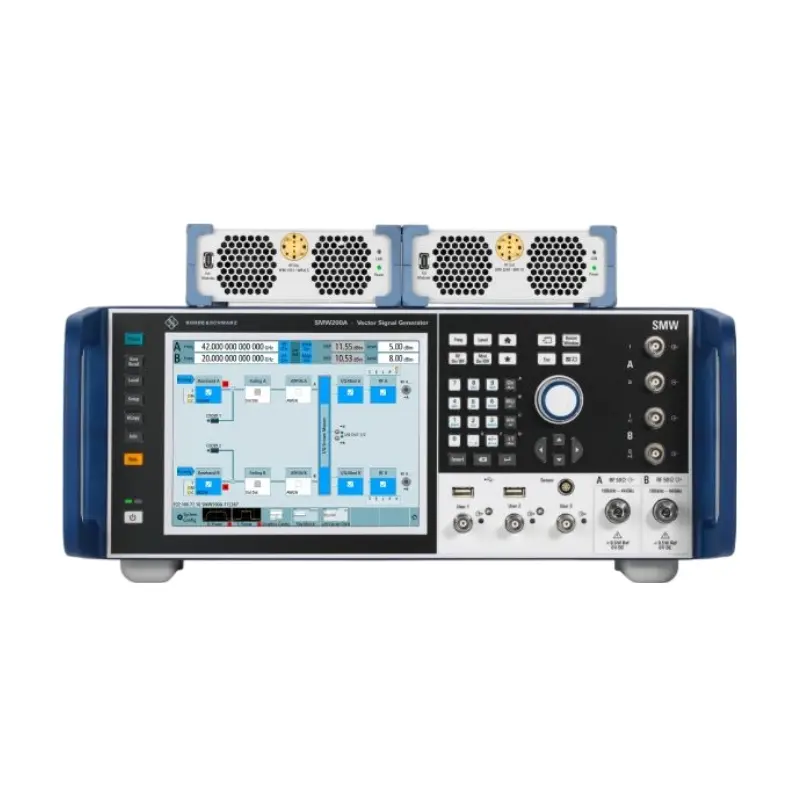
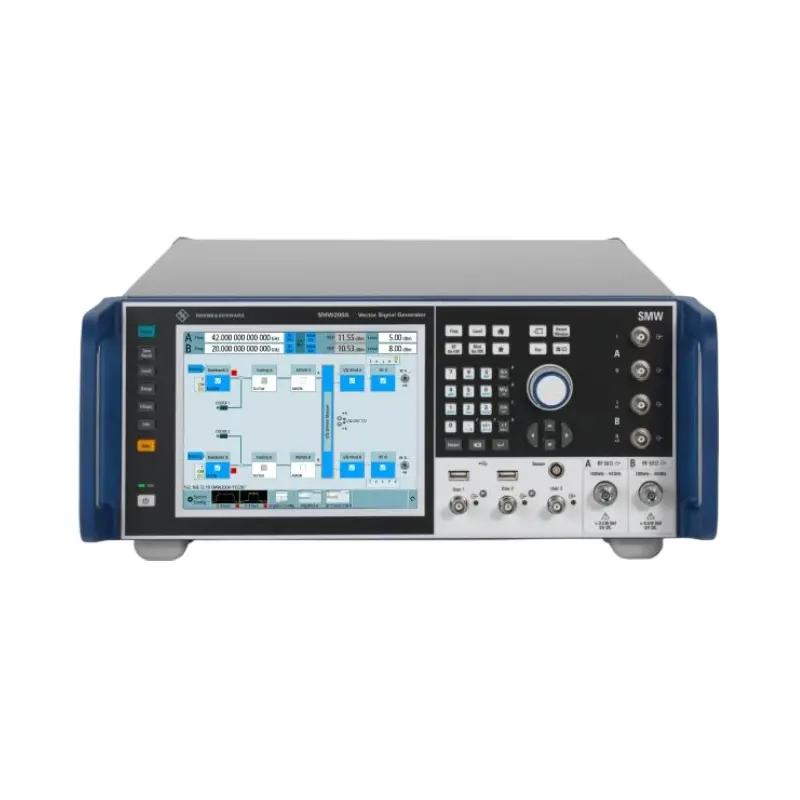
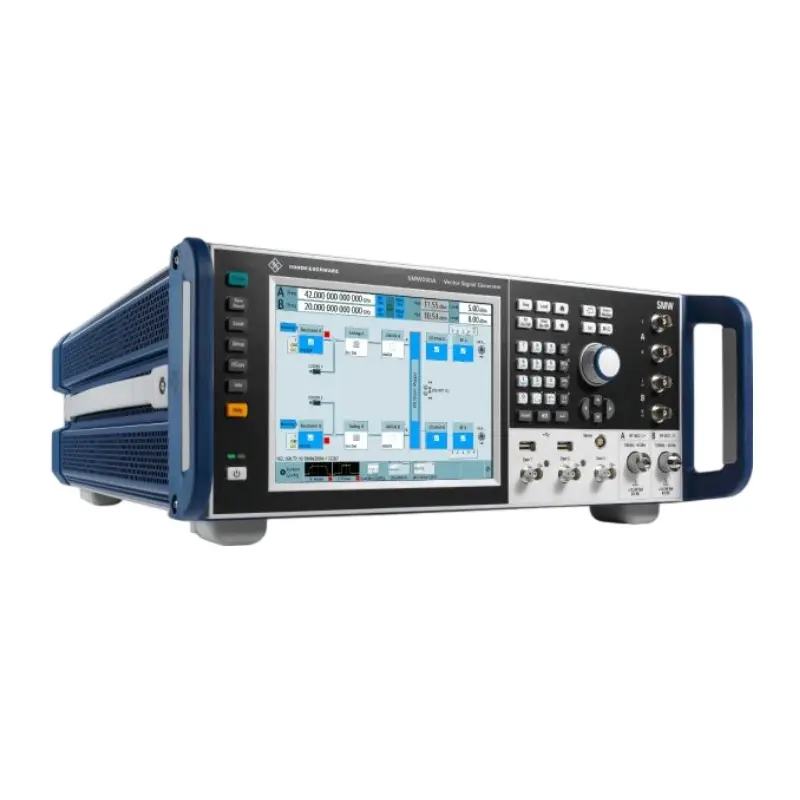
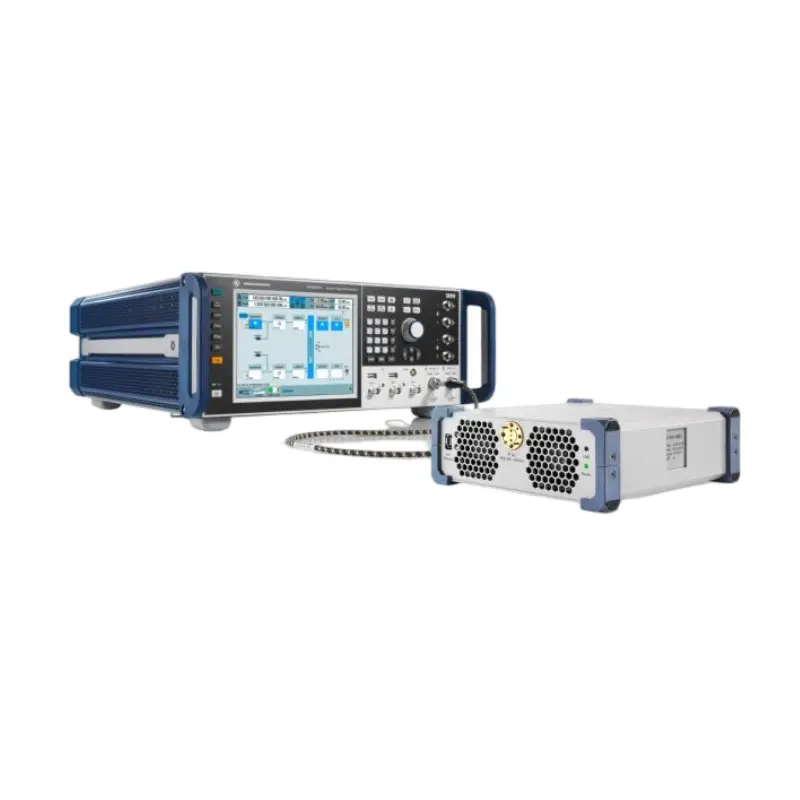
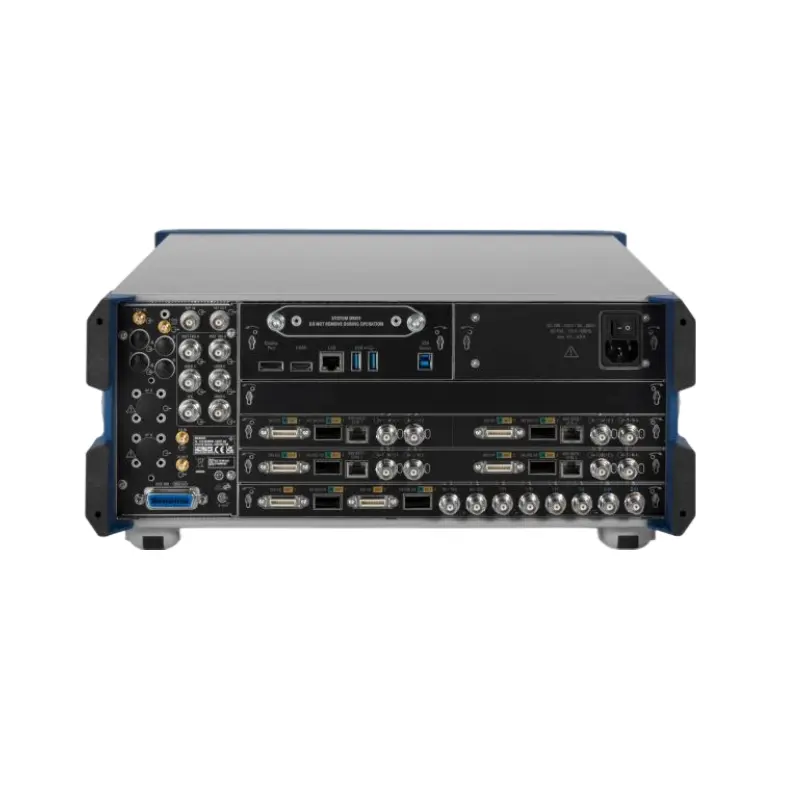
The Rohde & Schwarz R&S®SMW200A vector signal generator is a high-performance instrument designed for complex signal generation in various communication and radar testing scenarios.

Product Description

The R&S®SMW200A vector signal generator is a high-performance instrument designed for generating complex signals in a variety of communications and radar test scenarios. An overview is provided below:
Key Features
  • Wide frequency range: Single-channel instruments offer a frequency range of up to 67 GHz, while dual-channel instruments offer a frequency range of up to 44 GHz. Specific frequency ranges are available, depending on the model, from 100 kHz to 3 GHz, 6 GHz, 12.75 GHz, 20 GHz, 31.8 GHz, or 40 GHz.
  • High modulation bandwidth: The internal baseband unit generates signals with a maximum RF modulation bandwidth of 2 GHz. The wideband I/Q modulator with up to 2 GHz RF bandwidth meets the requirements of applications in wireless communications, satellite communications, and radar.
  • Excellent phase noise performance: The high-end synthesizer included as standard in the R&S®SMW200A delivers excellent SSB phase noise and inharmonic performance. Options such as the R&SSMW-B711/B721 ultra-low phase noise further enhance performance, making it suitable for measurements requiring spectral purity.
  • Precise frequency response flatness: The R&SSMW offers excellent RF frequency response flatness at the reference plane, with a specified value of less than 1 dB and a measured value of less than 0.4 dB over a modulation bandwidth of up to 2 GHz. This makes it an ideal signal source for a wide range of RF/microwave wideband test applications.
  • DUT de-embedding: The R&SSMW-K544 option enables the import of S2P files describing two-port interconnect networks for real-time DUT de-embedding. It can import up to 10 synchronized S2P files and automatically concatenates all S-parameter matrices, simplifying the de-embedding process.
  • Support for Multiple Communications Standards: It supports all major digital communications standards, including 5G, LTE (up to Release 12), 3GPP FDD/HSPA/HSPA+, GSM/EDGE/EDGE Evolution, CDMA2000®/1xEV-DO, and WLAN IEEE 802.11a/b/g/n/j/p/ac/ad.
  • MIMO and Fading Simulation: It supports all major MIMO modes, such as 3x3, 4x4, 8x2, 4x8, and 4x2x2. The optional integrated fading simulator can simulate channels with bandwidths up to 160 MHz, and up to four fading modules can be installed, providing up to 32 "logical" attenuators.
Technical Parameters
  • Level Range: -120 dBm to +18 dBm (peak effective bit) in the frequency range of 3 MHz ≤ f < 20 GHz. For models such as the R&S®SMW-B131 and R&S®SMW-B140/-B140N, the level range is from -120 dBm to +15/+18 dBm (peak effective bit), depending on the radio frequency (RF).
  • Settling time: In SCPI mode, the setting time is < 1.2 ms, typically 600 μs. For the R&S®SMW-B120/-B131/-B140/-B140N/-B220 with mechanical step attenuator switching, the setting time is < 25 ms.
  • Spectral purity: At levels < 10 dBm (CW), the harmonic level is < -30 dBc. For frequencies f > 3.5 GHz, the non-harmonic level is less than -55 dBc for the R&S®SMW-B120/-B131/-B140/-B140N/-B220. Under standard conditions, the non-harmonic level is less than -80 dBc.
Application Scenarios
  • Wireless Communications Testing: Suitable for the development and verification of new broadband communication systems, such as 5G NR FR3 research and 3G and 4G base station testing. It can also be used for power amplifier testing and other demanding RF applications.
  • Radar Signal Testing: It can generate radar signal scenarios for module, receiver, and DFS testing.
  • MIMO and Fading Channel Simulation: It can simulate complex MIMO and fading channel scenarios, aiding the research and development of related communications technologies.
Parameter Specification
Frequency Range 100 kHz - 67 GHz (single - path); up to 44 GHz (dual - path)
Level Range -120 dBm to +18 dBm
I/Q Modulation Bandwidth 2 GHz (internal); 2 GHz (external)
SSB Phase Noise < -137 dBc
Harmonics < -55 dBc (f > 3.5 GHz)
Power Supply AC input voltage range: 100 V to 240 V; AC input current range: max. 7.3 A to 4.6 A; AC supply frequency: 50 Hz to 60 Hz, 400 Hz
Power Consumption When fully equipped: 550 W (meas.)
Operating Temperature Range 5 °C to +45 °C
Storage Temperature Range -40 °C to +60 °C
Weight When fully equipped: 21 kg (46.3 lb)
Dimensions (W × H × D) 435 mm × 192 mm × 460 mm (17.1 in × 7.6 in × 18.1 in) (without front handles and instrument feet)
Models R&S®SMW200A vector signal generator
Features
  • Frequency range up to 67 GHz (dual path: up to 44 GHz)
  • 2 GHz modulation bandwidth
  • Integrated fading with up to 800 MHz bandwidth and up to 8x8 MIMO
  • Excellent signal quality for high accuracy in spectral and modulation measurements
  • Advanced GNSS and radar simulator
  • Dimension: 435 mm × 192 mm × 460 mm
  • Weight: 21kg
  • Battery parameters: Without battery
  • Delivery Information: Delivery information typically includes delivery times, shipping methods, packaging, etc., which may vary depending on the seller and the location of purchase.
R&S®SMW200A Datasheet

R&S®SMW200A vector signal generator datasheet.pdf

Download
R&S®SMW200A Brochure

R&S®SMW200A vector signal generator brochures.pdf

Download
Frequently Asked Questions

What is the frequency range of the R&S®SMW200A vector signal generator?

Single-channel instruments offer a frequency range of up to 67 GHz, while dual-channel models support up to 44 GHz. Depending on the specific configuration, options start from 100 kHz up to 3 GHz, 6 GHz, 12.75 GHz, 20 GHz, 31.8 GHz, or 40 GHz.

What is the maximum RF modulation bandwidth supported?

The generator features an internal baseband unit capable of generating signals with a maximum RF modulation bandwidth of 2 GHz.

Does the generator support real-time DUT de-embedding?

Yes. With the R&SSMW-K544 option, you can import up to 10 synchronized S2P files describing two-port interconnect networks to facilitate real-time DUT de-embedding.

Can this signal generator simulate MIMO and fading scenarios?

Yes. It supports major MIMO configurations (such as 3x3, 4x4, 8x2, 4x8, etc.) and features an optional integrated fading simulator that can simulate channels with bandwidths up to 160 MHz.

What are the physical dimensions and weight of the instrument?

Without front handles and feet, the instrument measures 435 mm × 192 mm × 460 mm and weighs 21 kg (46.3 lb) when fully equipped.

Related Products