Custom National Instruments(NI) PXIe-5698 26.5GHz PXI RF Amplifier Manufacturers, Exporter

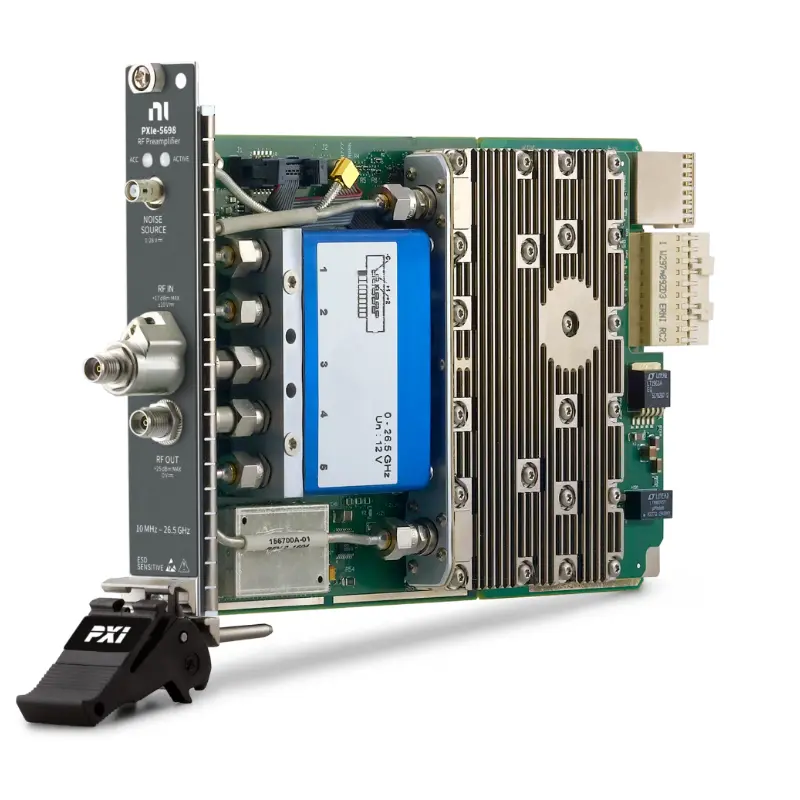
The PXIe-5698 is a radio frequency preamplifier designed as a single-slot PXI Express module. This module is designed to extend the test and monitoring capabilities of the PXIe-5668 Vector Signal Analyser, whilst also functioning as a standalone preamplifier. A mechanical relay-based RF signal bypass path enables removal of the preamplifier without reconnecting the system.

Product Description

Overview

The PXIe-5698 is a high-performance, compact RF power amplifier designed specifically for PXI Express (PXIe) test systems, optimized for amplifying RF signals up to 26.5 GHz. It integrates seamlessly into automated test environments (ATE) and research setups, delivering consistent gain, low distortion, and reliable performance—making it ideal for applications like RF component testing (e.g., filters, mixers), radar system prototyping, 5G sub-6 GHz and mmWave (up to 26.5 GHz) validation, and satellite communication module testing.

PXIe Integration

Occupies a single 3U PXIe slot, enabling high-speed communication and triggering synchronization (PXIe_TRIG 0–15) across multi-module test systems.

Built-in Protection

Features over-temperature shutdown, RF overload protection (limiting input power to ≤ +10 dBm), and reverse power safety mitigation.

Software & Control

Full driver support via NI-RFSA and NI TestStand, alongside APIs for LabVIEW, Python, C/C++, and .NET for custom automated testing.

Key Application Fields
  • RF Component Testing: Amplifying test signals to validate performance under realistic power levels for filters, mixers, or RFICs.
  • 5G & Wireless Validation: Supporting mid-band mmWave and sub-6 GHz testing of 5G transceivers, antennas, or small cells.
  • Aerospace & Defense: Stable signal amplification for radar module prototyping, satellite transceivers, and high-frequency testing.
  • Automated Test Equipment (ATE): Easy physical and functional integration into high-volume manufacturing lines.
Specifications
Specification Details
Product Model PXIe - 5698
Frequency Range 10 MHz to 26.5 GHz
RF Signal Conditioning Channels 1
Noise Figure at 1 GHz 3.6 dB
Output 1 dB Compression Point (P1dB) -12 dBm
Maximum Input Power (RF in) +17 dBm max (for frequencies >10 MHz), +10 dBm max (for frequencies <10 MHz)
Maximum Output Power (RF out) +25 dBm max
Connector Type 2.92 mm female
Power Requirements 6.93 W at +3.3 Vdc and 26.4 W at +12 Vdc, for a total of 33.33 W
Dimensions 8.5 x 0.8 x 5.1 in. (21.6 × 2.0 × 13cm)
Weight 17.6 oz. (0.5 kg)
Models & Delivery Information

Applicable Model: PXIe-5698 26.5GHz PXI RF Amplifier

Delivery information typically includes standard processing/delivery times, secure packaging, and localized shipping methods depending on the location of purchase.

Manuals & Resources
PXIe-5698 Preamplifier Module datasheet
PXIe-5698 26.5GHz Preamplifier Module Datasheet (PDF)
Download
Frequently Asked Questions
What is the frequency range of the PXIe-5698 amplifier?
The PXIe-5698 supports a wide frequency operating range from 10 MHz up to 26.5 GHz, making it suitable for both sub-6 GHz wireless and mmWave high-frequency test systems.
What are the input power limitations of this RF module?
The maximum input power (RF in) is +17 dBm max for frequencies above 10 MHz, and +10 dBm max for frequencies below 10 MHz. Built-in RF overload protection ensures protection against higher inputs.
What interface standard does the module use for RF signal lines?
The PXIe-5698 utilizes standard 2.92 mm female RF connectors for high-frequency signal reliability and impedance stability.
How does the module protect itself against overload and heating?
It has integrated hardware safeguards including over-temperature protection, which shuts the module down if temperature limits are exceeded, and reverse power protection to block energy reflected from mismatched device loads.
Which programming environments support the driver and calibration tools?
The amplifier is controlled via the NI-RFSA Driver and NI TestStand. It can be integrated into custom test sequences using LabVIEW, Python, C/C++, and .NET. Routine calibration utilizes NI Calibration Executive tools.

Related Products