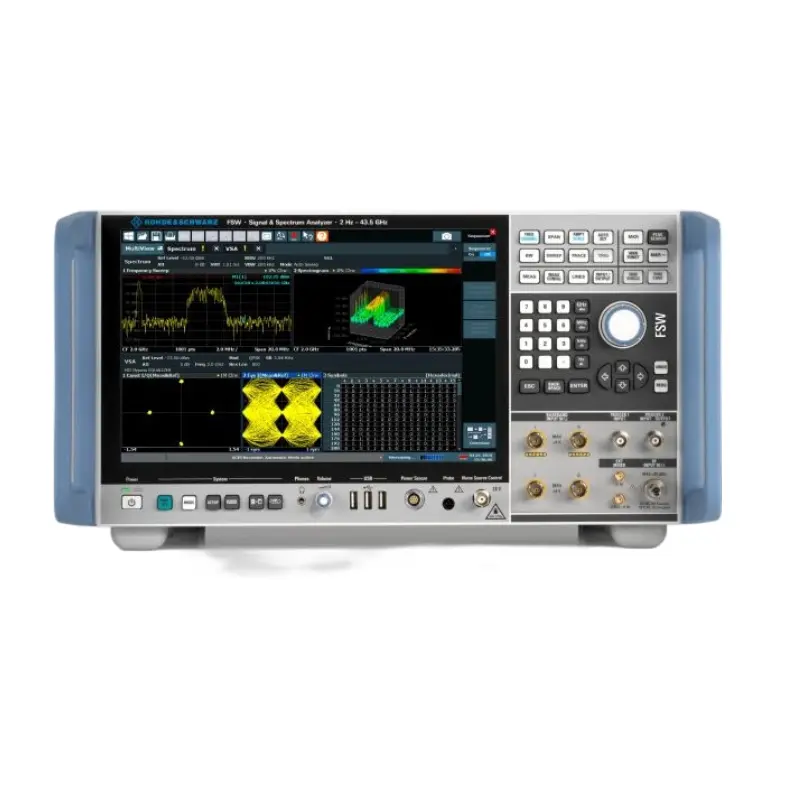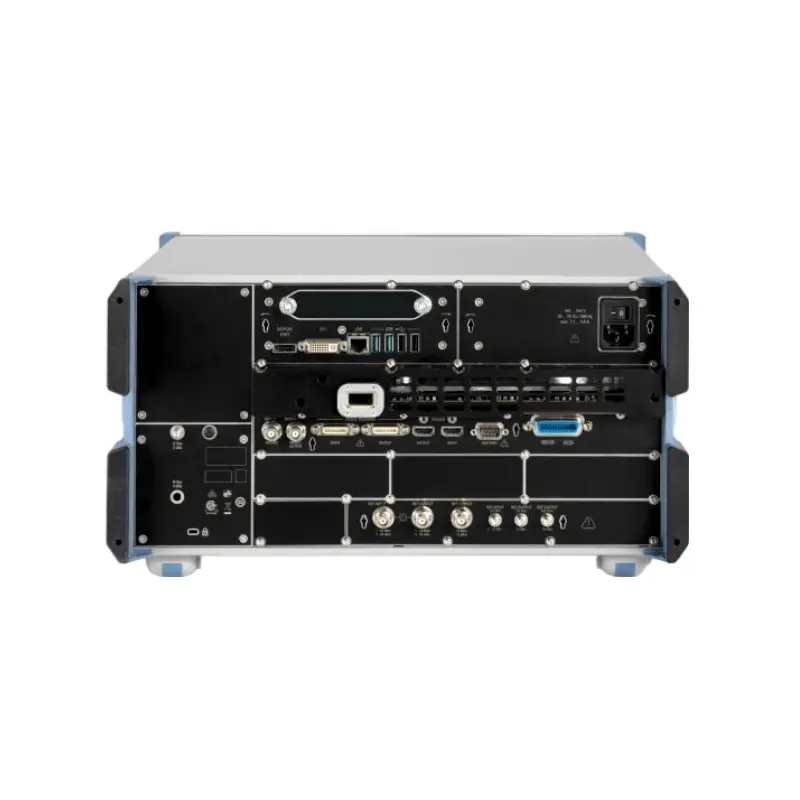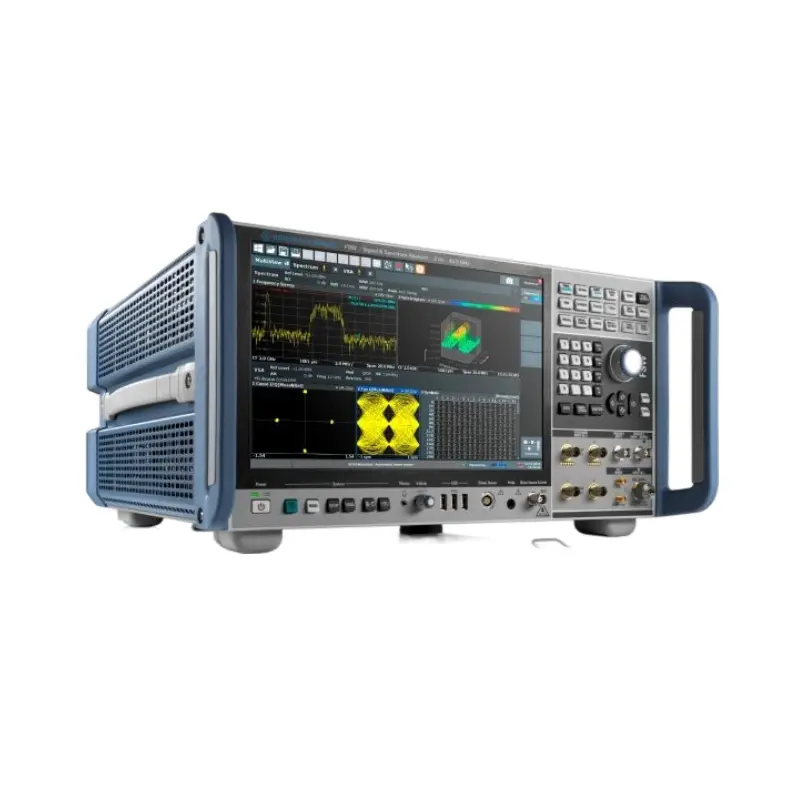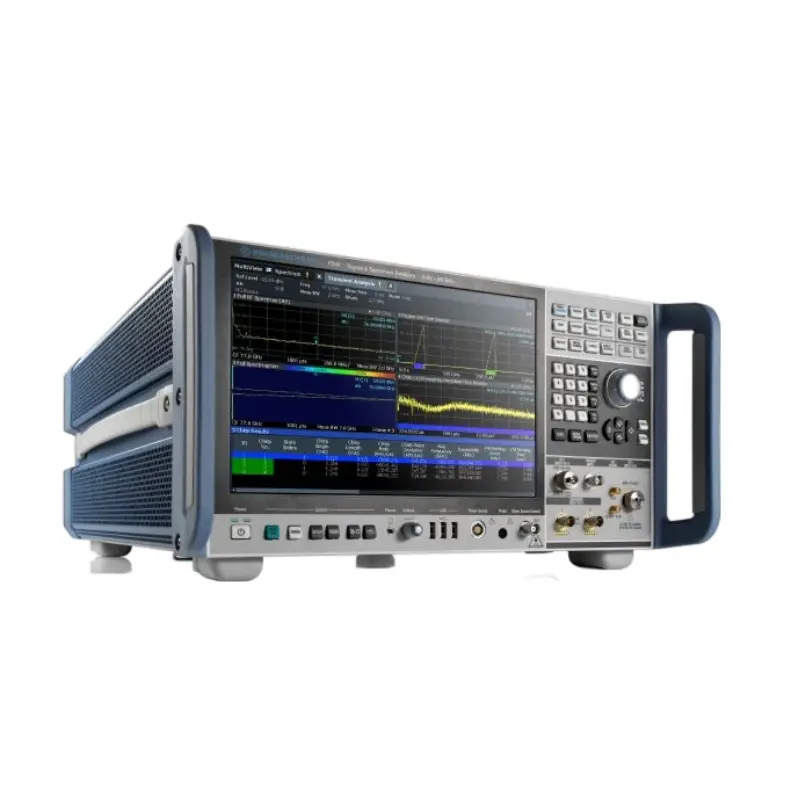
China Rohde & Schwarz R&S FSW67 Signa and Spectrum Analyzer 2Hz-67 GHz Manufacturer, Suppliers

The R&S®FSW67, as the high-end model in the R&S FSW series, builds upon its “2 Hz to 67 GHz wide frequency coverage.” With core performance features including “low noise, high dynamic range, and wide analysis bandwidth,” coupled with the flexibility of “modular expansion,” it stands as a flagship signal and spectrum analyzer that balances “research depth” with “production efficiency.” It not only meets current measurement demands in fields like 5G, satellite communications, and automotive radar, but also adapts to future technological advancements in 6G and higher-frequency millimeter-wave applications through expansion capabilities. This makes it an “all-around tool” in the high-end test and measurement domain.

Product Description

Product Overview

Rohde & Schwarz (R&S), a global leader in test and measurement equipment, has introduced the R&S®FSW67—a high-end signal and spectrum analyzer covering an ultra-wide frequency range from 2 Hz to 67 GHz. Designed for "high performance and multi-scenario adaptability," its core positioning addresses the precise measurement demands of RF, microwave, and even millimeter-wave (mmWave) applications, making it particularly suitable for cutting-edge communications, aerospace, defense electronics, and scientific research scenarios where measurement accuracy and functional scalability are paramount.

I. Core Specifications & Positioning

  • Frequency Range: 2 Hz to 67 GHz (direct coverage without external mixers; expandable to higher bands with R&S external mixer modules for millimeter-wave applications).
  • Instrument Type: Integrates "spectrum analysis" and "signal analysis" functions, supporting in-depth analysis of complex signals including continuous wave (CW), modulated signals (e.g., 5G NR, satellite communications), pulsed signals, and frequency-hopping signals.
  • Core Positioning: Targets high-end R&D (e.g., chip design, radar system development), stringent production testing (e.g., millimeter-wave device verification), and signal monitoring/compliance testing in aerospace/defense sectors.

II. Core Capabilities & Scalability

  • Standard Spectrum Analysis: Supports fundamental spectrum parameters including peak search, channel power, adjacent channel leakage ratio (ACLR), and spurious emission measurements.
  • Signal Analysis: Modulation analysis (amplitude/phase/frequency modulation), pulse signal analysis (pulse width, repetition period, duty cycle), power measurement (average power, peak power, peak-to-average ratio PAR).
  • Data Processing: Built-in signal recording and playback (stores massive raw signal data for offline analysis), multi-trace comparison (supports overlay analysis of results under different measurement conditions).

Optional Function Modules (Expandability)

  • Millimeter-wave Extension: When paired with R&S®FSW-Bxx series external mixers, the frequency range can be extended to 110 GHz, 325 GHz, or even higher, supporting millimeter-wave applications such as automotive radar (77/79 GHz) and satellite communications (Ka/Ku bands).
  • Real-Time Spectrum Analysis (RTSA): Activates real-time bandwidth (up to 250 MHz) via the optional R&S®FSW-K60 module, supporting "signal-triggered capture" (e.g., pulse triggering, level triggering) to capture transient signals.
  • Advanced Demodulation & Coding Analysis: The R&S®FSW-K100 module enables full demodulation of 5G NR millimeter-wave signals (including Massive MIMO parameter analysis), while the R&S®FSW-K70 module supports coding/decoding analysis of satellite communication signals (e.g., LDPC codes, Turbo codes).
  • Automation & Remote Control: Supports GPIB, LAN (LXI standard), USB, and other interfaces. Automated testing can be achieved via R&S®VISA software or custom SCPI commands (e.g., integration into unattended test systems on production lines).

III. Typical Application Scenarios

Communications: 5G NR mmWave, satellite links (VSAT, HTS), & IoT narrowband (LoRa).
Aerospace & Defense: Radar systems parameters, missile guidance RF validation, anti-jamming.
Research & Semiconductors: mmWave chips (MMICs), 6G pre-research, RF physical layer labs.
Industrial & Automotive: Automotive radar (77 GHz) calibration & IIoT signal monitoring.

Specifications

Specification Category Details
Frequency Range
  • Standard: 2 Hz to 67 GHz (direct measurement, no external mixer required)
  • Extended: Up to 1.1 THz with optional external mixers (e.g., R&S®FSW-B110 for 110 GHz, R&S®FSW-B325 for 325 GHz)
Frequency Accuracy
  • ±(1 × 10⁻¹¹ × f₀ + 1 Hz) after 24 h warm-up (f₀ = measured frequency)
  • Reference oscillator: OCXO (oven-controlled crystal oscillator) as standard; optional rubidium oscillator for higher stability
Spectral Performance
  • Displayed Average Noise Level (DANL): Typical -170 dBm/Hz (at 1 GHz, 1 Hz RBW, preamplifier on)
  • Third-Order Intercept Point (TOI): Typical +15 dBm (at 1 GHz, 10 MHz RBW)
  • RBW Range: 1 Hz to 10 MHz (1-3-10 step sequence); optional 20 MHz/40 MHz RBW
Analysis Bandwidth
  • Standard: Up to 100 MHz (baseband I/Q capture)
  • Optional: Up to 1.5 GHz with R&S®FSW-K106 (1.5 GHz IF bandwidth module)
Measurement Speed
  • Sweep Speed: Up to 100 GHz/s (spectral sweep, 1 Hz RBW)
  • Real-Time Spectrum Analysis (RTSA): Optional, max real-time bandwidth 250 MHz (R&S®FSW-K60), minimum event detection time < 1 μs
Signal Analysis Capabilities
  • Modulation Formats: Supports 5G NR, 4G LTE/LTE-A, Wi-Fi 6/6E, DVB-S2X, Bluetooth, and custom modulated signals
  • Demodulation Metrics: MER (±0.2 dB accuracy), EVM, phase error, amplitude error
  • Pulse Signal Analysis: Pulse width, PRF, duty cycle, rise/fall time measurement (min pulse width: 10 ns)
Phase Noise
  • Typical -128 dBc/Hz (at 1 GHz carrier, 10 kHz offset; 1 Hz RBW)
  • Typical -145 dBc/Hz (at 1 GHz carrier, 1 MHz offset; 1 Hz RBW)
Input Characteristics
  • Input Impedance: 50 Ω (standard)
  • Max Input Power: +20 dBm (without damage); +30 dBm (with optional R&S®FSW-K43 high-power attenuator)
  • Preamplifier: Built-in (1 GHz to 67 GHz), switchable
Interface & Connectivity
  • LAN (1 Gbit/s, LXI Class C compliant)
  • GPIB (IEC/IEEE 488.2)
  • USB 3.0 (front & rear panels)
  • Trigger I/O (BNC, for external trigger/instrument synchronization)
  • HDMI (for external display)
Physical & Environmental
  • Dimensions (W × H × D): 442 mm × 177 mm × 635 mm (19-inch rack-mountable)
  • Weight: Approximately 26 kg
  • Operating Temperature: 0 °C to 40 °C (at ≤ 90% relative humidity, non-condensing)
Operating System & Software
  • Built-in PC with Windows 10 Pro
  • Standard software: R&S®FSW-BASE (spectral analysis), R&S®FSW-SIGNAL (basic signal analysis)
  • Optional software: R&S®FSW-K100 (5G NR analysis), R&S®FSW-K70 (satellite signal analysis), R&S®FSW-K60 (RTSA)

Model Highlights

Rohde & Schwarz R&S FSW67 Signal and Spectrum Analyzer 2Hz-67 GHz
Unparalleled low phase noise and best sensitivity on the market
8.3 GHz internal analysis bandwidth
800 MHz real-time analysis bandwidth
SCPI recorder simplifies code generation
High dynamic range enables outstanding EVM performance

Delivery Information

  • Dimension: 461 * 240 * 505 mm
  • Weight: 23.6 kg
  • Battery parameters: Without battery

Delivery information typically includes delivery times, shipping methods, packaging, etc., which may vary depending on the seller and the location of purchase.

Manuals & Resources

Rohde & Schwarz R&S FSW67 Signal and Spectrum Analyzer 2Hz-67 GHz Documentation
R&S FSW67 Manual
Rohde & Schwarz R&S FSW67 Signal and Spectrum Analyzer 2Hz-67 GHz manual.pdf
Download
R&S FSW67 Datasheet
Rohde & Schwarz R&S FSW67 Signal and Spectrum Analyzer 2Hz-67 GHz datasheet.pdf
Download
R&S FSW67 Database
Rohde & Schwarz R&S FSW67 Signal and Spectrum Analyzer 2Hz-67 GHz database.pdf
Download

Frequently Asked Questions

Q1: What is the native frequency range of the R&S®FSW67 spectrum analyzer?
The R&S®FSW67 features a standard, direct measurement frequency range from 2 Hz up to 67 GHz without requiring external mixers.
Q2: Can the frequency range of the R&S®FSW67 be extended beyond 67 GHz?
Yes. By using optional external mixers (such as the R&S®FSW-B110 or R&S®FSW-B325 modules), the analysis range can be extended up to 1.1 THz to accommodate millimeter-wave and sub-millimeter-wave applications.
Q3: What is the maximum analysis bandwidth available for the R&S®FSW67?
The instrument supports a standard analysis bandwidth of up to 100 MHz, which can be optionally upgraded up to 1.5 GHz using specialized hardware modules like the R&S®FSW-K106, or up to 8.3 GHz internal analysis bandwidth depending on hardware configurations.
Q4: Does the R&S®FSW67 support real-time spectrum analysis (RTSA)?
Yes. Real-time spectrum analysis can be integrated using optional software modules (e.g., R&S®FSW-K60), enabling a real-time bandwidth of up to 250 MHz or higher with minimal event detection times for capturing transient or pulsed signals.
Q5: What interfaces are supported for remote automation and instrumentation?
The analyzer supports standard industry interfaces including LAN (compliant with LXI Class C), GPIB (IEC/IEEE 488.2), USB 3.0, and HDMI for external displays. Automated test scripts can run via R&S®VISA or standard SCPI commands.
Q6: What operating system runs on the built-in PC of the R&S®FSW67?
The analyzer features an integrated computer system running the Windows 10 Pro operating system, facilitating easy file handling, network integration, and standard software execution.

Related Products