Home >
Battery analyzers >
Best National Instruments(NI) USB-5684 18GHz Wide Dynamic Range Power Sensor Exporter, Product
1 / 1
Best National Instruments(NI) USB-5684 18GHz Wide Dynamic Range Power Sensor Exporter, Product
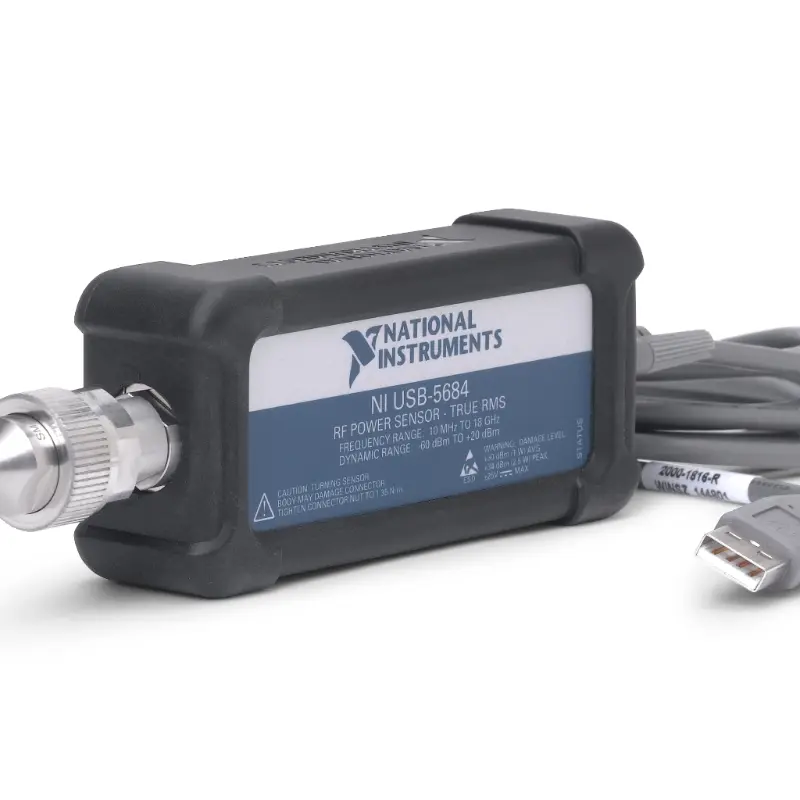
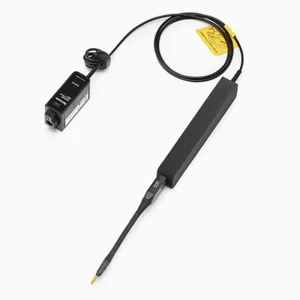
The USB-5684 features a wide dynamic range and high measurement accuracy, with dimensions comparable to a typical power supply head. As a true root mean square (RMS) power sensor, it delivers ultra-high precision average power measurements for monophonic, polyphonic signal sources, and even complex broadband digital waveforms. This device is particularly suited for mobile applications or integration into automated test systems, freeing up valuable rack space while maintaining exceptional performance.
The USB-5684 is a compact, high-performance USB-connected RF power sensor designed for precise power measurement of RF signals up to 18 GHz. Engineered for flexibility—supporting both benchtop testing and field deployment—it delivers wide dynamic range, fast measurement speeds, and seamless software integration, making it ideal for applications like RF component characterization (e.g., amplifiers, filters), wireless device testing (5G, Wi-Fi), radar system validation, and satellite communication signal monitoring.
1. Hardware Design: Portability & Ruggedness
Built for both lab and field use, the USB-5684 combines a compact form factor with durable construction:
USB Connectivity: Uses a USB 3.0 interface for plug-and-play operation. It eliminates the need for bulky external power supplies (powered directly via USB) and enables easy integration with laptops for portable testing.
RF Input: Equipped with a 2.92 mm female connector (compatible with SMA adapters via 2.92 mm-to-SMA converters) — a precision RF connector ideal for high-frequency applications, ensuring low insertion loss and reliable signal transfer up to 18 GHz.
Form Factor & Durability: Compact dimensions (107 mm × 64 mm × 25 mm / 4.2 in × 2.5 in × 1.0 in) and lightweight design (≈150 g / 5.3 oz) for easy transport. Meets industrial ruggedness standards: operating temperature range of 0 °C to 55 °C (32 °F to 131 °F) and resistance to shock (50 G, 0.5 ms half-sine) and vibration.
Built-In Calibration: Includes an internal calibration reference (temperature-compensated) to maintain accuracy over time and environmental changes. Supports external calibration tools for compliance with strict industry standards.
2. Software & System Integration
The USB-5684 leverages an advanced software ecosystem to simplify configuration, automation, and data analysis:
Driver Support: Controlled via the RF Power Sensor Driver, which provides low-level access to measurement settings (e.g., frequency, power range, averaging) and data streaming. Compatible with LabVIEW, Python, C/C++, and .NET.
Continuous Mode: For real-time signal monitoring (e.g., tracking power fluctuations in a wireless link).
Test Automation: Integrates with TestStand for building automated test sequences and LabVIEW SignalExpress for quick, no-code measurement setup and data visualization.
Third-Party Compatibility: Compatible with popular RF test software via standard VISA drivers, ensuring flexibility for mixed-instrument test systems.
3. Typical Applications
The USB-5684's combination of precision, portability, and wide dynamic range makes it versatile across industries:
RF Component Testing
Characterizing power amplifiers, filters, mixers, and RFICs—measuring output power, insertion loss, and power flatness across frequencies.
Wireless Validation
Testing 5G smartphones, Wi-Fi access points, and IoT devices—verifying compliance with regulatory power limits and signal quality.
Aerospace & Defense
Monitoring radar signals, satellite communication links, and avionics systems—measuring transient power levels in field or lab environments.
Specifications
Specification
Details
Model
USB-5684
Frequency Range
10 MHz – 18 GHz
Dynamic Range
-60 dBm to +20 dBm
Measurement Accuracy
Typical power accuracy: ±0.2 dB (at 1 GHz, -30 dBm to +10 dBm, 23 °C ±5 °C); Frequency flatness: ±0.3 dB (across 10 MHz – 18 GHz, referenced to 1 GHz); Temperature coefficient: ±0.005 dB/°C (0 °C – 55 °C)
Measurement Speed
Burst mode: Up to 10,000 measurements per second; Continuous mode: Up to 1,000 measurements per second
Signal Types Supported
True RMS power measurement (compatible with sinusoidal, modulated, and transient signals)
RF Input Interface
Connector type: N type male; Input impedance: 4 kohms
Connectivity
USB interface
Power Consumption
Draws only 450 mA from the USB connection
Operating Temperature
0 °C – 50 °C
Storage Temperature
-40 °C – 71 °C
Dimensions
4.33 x 1.77 x 1.01 inches
Weight
0.88 lb
Typical Linearity
±0.11 dB
Measurement Resolution
1 dB, 0.1 dB, and 0.01 dB
Aperture Time
0.01 ms to 1 s (depending on the mode of operation)
Models & Delivery Information
Models & Physical Specifications
Model Name: USB-5684 18GHz Wide Dynamic Range Power Sensor
RF Range: 18 GHz, -60 dBm to +20 dBm Power Range RF Power Sensor Device
Physical Dimensions: 110.08 x 44.96 x 25.65 mm
Weight (packaged): 400 g / 0.88 lb
Delivery Information
Delivery information typically includes delivery times, shipping methods, packaging, etc., which may vary depending on the seller and the location of purchase.
Manuals + Resources
USB-5684 Wide Dynamic Range Power Sensor Datasheet.pdf
Download Document
Frequently Asked Questions (FAQ)
What is the frequency range of the USB-5684 RF Power Sensor?
The USB-5684 supports a wide frequency range from 10 MHz up to 18 GHz, making it suitable for high-frequency RF and microwave applications.
What is the dynamic range of the USB-5684 sensor?
The sensor features a wide dynamic measurement range of -60 dBm to +20 dBm, allowing it to accurately measure both very low and high-power RF signals.
How fast can the USB-5684 perform power measurements?
In Burst Mode, the sensor can capture up to 10,000 measurements per second. In Continuous Mode, it operates at speeds up to 1,000 measurements per second.
What interface does the USB-5684 use for communication and power?
The sensor utilizes a USB interface (drawing only 450 mA), which provides both communication and power from the host computer, removing the need for external power supplies.
What types of signals can the USB-5684 measure?
The sensor supports True RMS power measurement, making it compatible with sinusoidal, modulated, and transient signals, such as radar pulses and 5G time-domain signals.
What are the typical software environments supported by this sensor?
It is supported by the RF Power Sensor Driver and integrates seamlessly with platforms like LabVIEW, LabVIEW SignalExpress, TestStand, and can be customized using Python, C/C++, and .NET.
 Machine-Win