Choosing a battery chemistry is not just a specification-sheet decision. It affects vehicle range, charging behavior, cost, and performance in cold weather. For stationary storage, lifespan and safety may matter more than compact size. A Lithium-Ion Battery is therefore best judged by its intended use, not by one headline number.
The International Energy Agency reported that lithium iron phosphate (LFP) batteries supplied around 40% of the global electric-car battery market in 2023, a substantial rise from earlier years (Global EV Outlook 2024). LFP is often valued for cost and thermal stability, while nickel-based chemistries, including NMC and NCA, can offer higher energy density. Neither advantage settles the choice. The trade-off is real.
This guide compares the leading chemistries: LFP, NMC, NCA, lithium manganese oxide (LMO), lithium cobalt oxide (LCO), and lithium titanate (LTO). They are not perfectly equivalent categories: LTO, for example, refers to an anode chemistry, while several others describe cathode materials. That distinction is easy to miss. We will look at typical strengths, limitations, and common applications, while treating published performance figures as context rather than guarantees. Actual results depend on cell design, operating conditions, and battery management. No chemistry wins everywhere.
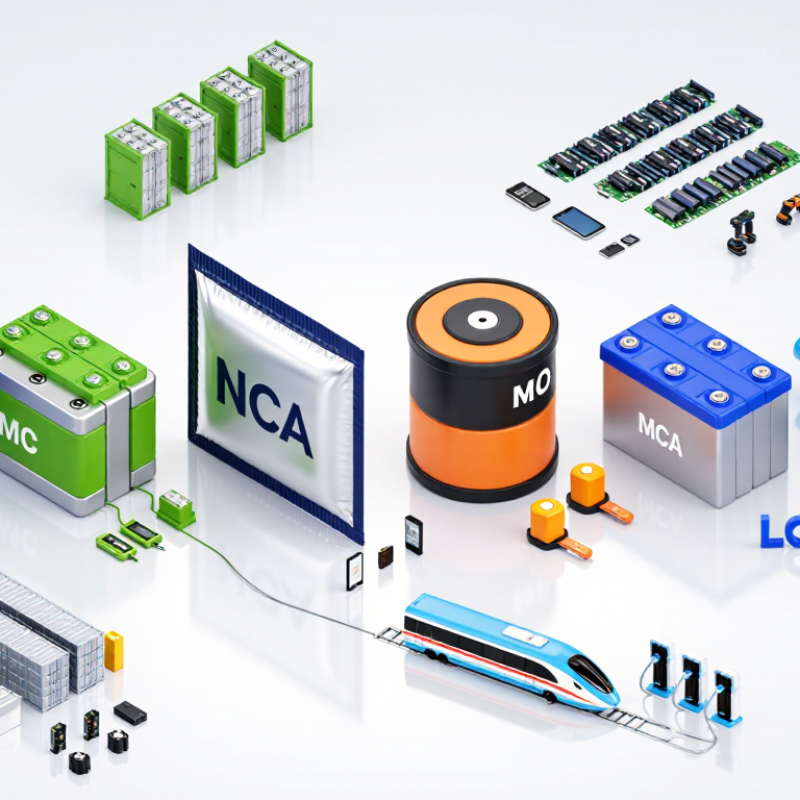
How Lithium-Ion Battery Chemistries Are Classified
Lithium-ion batteries are classified mainly by their cathode chemistry, not by the word “lithium” alone. The cathode shapes key trade-offs in energy density, power, cost, and thermal stability. Common families include LFP, NMC, NCA, LCO, and LMO. Their names describe different cathode materials: LFP uses iron phosphate, while NMC combines nickel, manganese, and cobalt. Chemistry is not a single recipe. Ratios and cell designs vary, so two batteries with the same label may still perform differently.
The International Energy Agency’s Global EV Outlook 2024 reports that LFP supplied nearly 40% of the global electric-vehicle battery market in 2023, up from less than 10% in 2020. That figure applies to EV batteries, not every lithium-ion application. It also shows why classification matters: LFP is often chosen for durability and cost, while nickel-rich chemistries can offer higher energy density. These are tendencies, not guarantees. Pack design and operating conditions matter, too. One label cannot tell the whole story.
Tips: Check the full chemistry, voltage, and safety specifications on a cell’s datasheet. For example, don’t assume every “lithium-ion” pack has the same charging limits. LTO is a useful exception: its name refers to an anode material, so chemistry labels do not always follow one neat rule.
Lithium Iron Phosphate (LFP): Safety and Cycle Life
Lithium iron phosphate, or LFP, is valued for its thermal stability and long service life. Its chemistry is less prone to oxygen release during overheating than some other lithium-ion chemistries. That can reduce fire risk, but it does not make a battery fireproof. Proper cell design, a battery management system, and sound installation still matter.
LFP batteries can often withstand many charge and discharge cycles before their usable capacity falls substantially. The actual cycle count depends on temperature, charging rate, depth of discharge, and operating limits. A battery used gently in a ventilated room may age differently from one repeatedly pushed hard in a hot enclosure. Check the manufacturer’s test conditions; cycle-life figures are not directly comparable otherwise.
In everyday use, LFP’s stable output can suit stationary storage and frequent cycling. The trade-off is lower energy density than some alternatives, so a pack may need more space for the same stored energy. Cold weather can also slow charging, even when the battery remains operational. A little caution helps. It is tempting to treat “long life” as a guarantee, but real-world results depend on maintenance and system design, and those details are easy to overlook.
Nickel-Based Chemistries: NMC and NCA
Nickel-based lithium-ion batteries use cathodes built around nickel, with manganese and cobalt in NMC cells, or aluminum and cobalt in NCA cells. More nickel can raise energy density, helping electric vehicles travel farther without carrying a much larger pack. The trade-off is demanding thermal management and careful charging control. Heat still matters.
The International Energy Agency’s Global EV Outlook 2024 reports that electric-vehicle battery demand exceeded 750 GWh in 2023; lithium iron phosphate batteries captured nearly 40% of the market. Nickel-based chemistries remain important where range and compact pack size matter. In practice, a driver may notice their advantage on a long highway trip, but cold weather, fast charging, and cabin heating can still reduce usable range. Pack design matters too: cell spacing and cooling channels affect how evenly temperatures rise. NMC and NCA are not interchangeable, and neither chemistry guarantees better performance in every vehicle. A useful comparison should consider the whole pack, not just the cathode. Real-world results can be less neat than a specification sheet suggests.
Nickel-Based Lithium-Ion Chemistries: NMC vs. NCA
NCA cells generally offer higher gravimetric energy density than NMC cells. These approximate cell-level ranges vary with cell design and should be treated as indicative, not guaranteed specifications.
Lithium Titanate (LTO) and Key Differences Among Battery Types
What Are the Top Types of Lithium Ion Batteries?
Lithium Titanate (LTO) and Key Differences Among Battery Types
Lithium-ion batteries use different electrode materials, and those choices shape their performance. LTO replaces the usual graphite anode with lithium titanate. It can charge quickly and withstand many charge cycles, making it useful for frequent-use equipment and some energy-storage systems. There is a trade-off: LTO usually stores less energy for its size and weight than chemistries such as NMC or NCA. LFP prioritizes durability and thermal stability, while LCO is often chosen where compact energy storage matters. No chemistry wins every comparison.
Tips: Check the full battery specification, not just the chemistry name. Compare usable capacity, rated cycle life, charging limits, operating temperature, and warranty conditions. For example, a fast-charge rating may depend on temperature and the charger. Keep that detail in mind.
LTO can perform well in cold conditions compared with many lithium-ion types, but cold still affects battery performance. Its long cycle life may reduce replacement frequency, though the higher purchase cost can change the total cost calculation. NMC and NCA offer higher energy density, but their usable life and thermal behavior depend on cell design and operating conditions. Specifications vary between manufacturers. That makes broad rankings a little imperfect. Match the chemistry to the job: a lightweight device has different needs from a bus that charges repeatedly throughout the day.
What Are the Top Types of Lithium Ion Batteries? – Lithium Titanate (LTO) and Key Differences Among Battery Types
The figures below are indicative ranges for cells and vary with design, operating conditions, and test methods. Cycle life is especially dependent on temperature, charge/discharge rate, and depth of discharge.
| Battery chemistry |
Typical nominal cell voltage |
Indicative cell-level energy density |
Indicative cycle life |
Key strengths |
Trade-offs and common uses |
| Lithium titanate (LTO) |
About 2.3–2.4 V |
About 50–90 Wh/kg |
About 3,000–10,000+ cycles |
Very fast charging capability, long cycle life, and good low-temperature performance in suitable designs |
Lower energy density and higher cost per unit of stored energy; used where fast charging and durability matter |
| Lithium iron phosphate (LFP) |
About 3.2 V |
About 90–180 Wh/kg |
About 2,000–6,000 cycles |
Strong thermal stability, long service life, and no nickel or cobalt in the cathode |
Lower energy density than many nickel-rich chemistries; common in electric vehicles and stationary storage |
| Lithium nickel manganese cobalt oxide (NMC) |
About 3.6–3.7 V |
About 150–250 Wh/kg |
About 1,000–3,000 cycles |
Balanced energy density, power capability, and service life; composition can be adjusted for different priorities |
Contains nickel and cobalt; thermal management and battery controls are important. Used in vehicles and portable equipment |
| Lithium nickel cobalt aluminum oxide (NCA) |
About 3.6–3.7 V |
About 200–280 Wh/kg |
About 1,000–2,000 cycles |
High energy density and good specific power in suitable cell designs |
Uses nickel and cobalt and requires careful thermal and charge management; used where range and compact size are priorities |
| Lithium cobalt oxide (LCO) |
About 3.6–3.7 V |
About 150–240 Wh/kg |
About 500–1,000 cycles |
High energy density in compact cells |
Contains cobalt and typically has more limited cycle life and thermal stability than LFP; common in small consumer electronics |
| Lithium manganese oxide (LMO) |
About 3.7–4.0 V |
About 100–160 Wh/kg |
About 500–1,500 cycles |
Good power capability and generally lower reliance on cobalt than LCO or NMC |
Often has lower energy density and cycle life; used in power tools and some vehicle or hybrid designs |
Note: Energy density and cycle-life figures are broad, illustrative ranges rather than guaranteed specifications. Pack-level values are usually lower than cell-level values because packs include housing, wiring, cooling, and control systems.
Conclusion
Lithium-Ion Battery types are classified by the materials used in their cathodes and anodes, which shape their energy capacity, power output, safety, lifespan, and charging characteristics. Lithium cobalt oxide (LCO) offers high energy density, while lithium manganese oxide (LMO) is known for strong power delivery. Each chemistry involves trade-offs, so the right choice depends on how the battery will be used.
Lithium iron phosphate (LFP) is valued for its thermal stability and long cycle life. Nickel-based chemistries, including nickel manganese cobalt oxide (NMC) and nickel cobalt aluminum oxide (NCA), balance energy density, performance, and durability in different ways. Lithium titanate (LTO) stands out for fast charging and long service life, though it typically provides less energy per unit of weight. Understanding these differences helps match a battery chemistry to its intended application.

 Machine-Win