China’s counters and timers industry is moving from basic panel devices toward connected, programmable control equipment. This shift reflects wider factory automation demand.
Grand View Research valued the global industrial automation and control systems market at approximately USD 166 billion in 2023. Its report also projects strong growth through 2030. ResearchAndMarkets reports similar expansion across programmable controllers, sensing devices, and industrial timing systems. These figures do not measure Counters And Timers alone. However, they show the commercial environment surrounding Chinese manufacturers.
China remains important because it combines electronic component access, large-scale assembly, and flexible customization. A factory floor may contain compact digital counters, DIN-rail timers, relay modules, and touchscreen controllers. Each device must handle dust, vibration, voltage fluctuation, and repeated switching. Small errors can stop a packaging line.
Reliability matters more than a polished catalogue.
Reliability engineer Dr. Michael Pecht defines it clearly: “Reliability is the probability that a product will perform its intended function for a specified period of time under stated conditions.” This principle guides our review of China’s top ten manufacturers. We examine product range, timing accuracy, certifications, testing practices, export experience, and technical support. Claims are compared with available company records and independent market information. Yet no ranking is perfect. Some manufacturers publish limited field data, while others provide impressive specifications but weaker after-sales service. That gap deserves attention. Buyers should verify sample performance, warranty terms, enclosure ratings, and response times before signing large contracts. The following overview therefore treats scale as only one factor. Practical reliability may matter more than the loudest marketing promise.
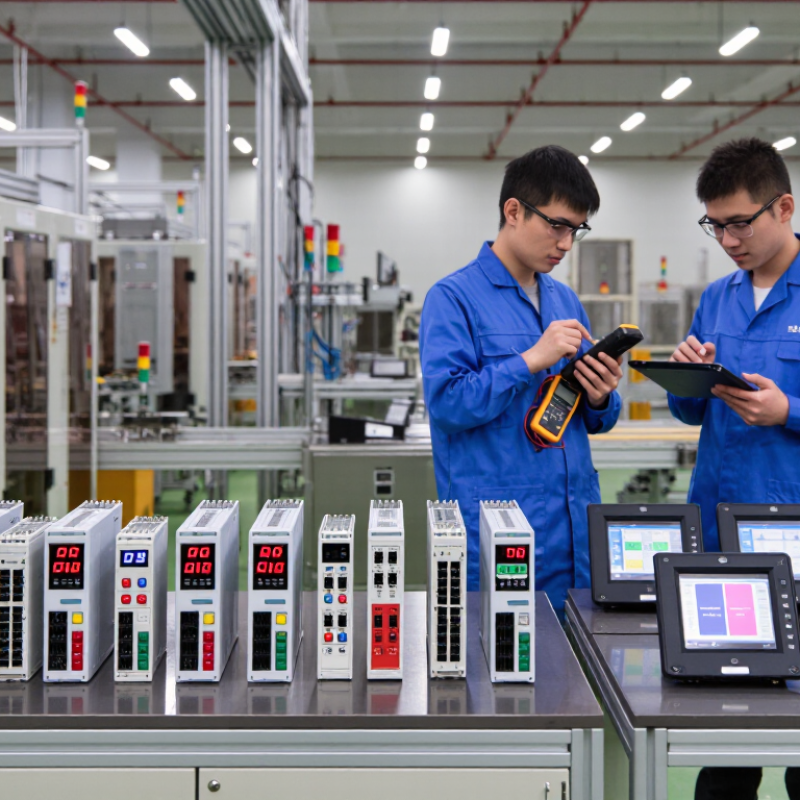
In industrial automation, counters and timers are small control functions with major practical value. A counter records events, such as bottles passing a sensor or motor cycles reaching a maintenance limit. A timer measures delay, duration, or interval. This allows a machine to start, pause, reject, or stop equipment without constant operator input.
Under IEC 61131-3, counters and timers are standard programming elements in programmable control systems. Common types include up counters, down counters, on-delay timers, and off-delay timers. Engineers often select them by timing range, voltage tolerance, response speed, display clarity, and resistance to dust or vibration. A factory floor is rarely gentle. Heat and electrical noise can expose weak designs quickly.
The MarketsandMarkets PLC report estimated the PLC market at about USD 12.6 billion in 2023, with growth toward USD 16.9 billion by 2028. This growth reflects wider demand for compact, connected control hardware. Another industry report may show different figures. That is worth questioning, because research methods and market boundaries vary. In China, manufacturers serving this sector commonly develop panel-mounted and modular counters and timers for packaging, material handling, energy systems, and process equipment. Buyers should verify cycle accuracy, memory retention, communication options, and test results before comparing prices. A low-cost unit can appear efficient, but repeated timing errors may create larger production losses. Reliability is not just a catalog claim.
Generic industrial counter and timer technology overview; specifications are typical application ranges and may vary by product series.
| No. | Device Type | Primary Function | Typical Input Signals | Typical Operating Range | Common Output | Typical Industrial Applications |
|---|---|---|---|---|---|---|
| 1 | Up Counter | Increases the count by one for each valid input pulse. | Proximity sensor, photoelectric sensor, encoder pulse, pushbutton | Usually 24 V DC; pulse frequency commonly from a few hertz to several kilohertz | Preset reached signal, relay contact, transistor output, PLC bit | Part counting, packaging, indexing, production quantity tracking |
| 2 | Down Counter | Decreases a preset value until the target reaches zero. | Pulse input, reset input, load or preset input | 24 V DC control systems are common; count capacity depends on controller resolution | Zero-count output, stop command, alarm signal | Remaining-piece control, batch completion, material dispensing |
| 3 | Up/Down Counter | Adds or subtracts counts according to direction or paired pulse inputs. | Quadrature encoder, two-phase encoder, separate up and down pulses | Commonly 5 V or 24 V DC logic; speed depends on input filtering and scan rate | Position value, limit output, motion-control reference | Conveyor position, servo feedback, elevator position, linear displacement |
| 4 | High-Speed Counter | Counts fast pulses independently of the normal PLC scan cycle. | Encoder output, high-speed proximity sensor, pulse generator | Often several kilohertz to hundreds of kilohertz, depending on hardware | Hardware compare output, interrupt, position register | High-speed positioning, cutting length control, speed measurement |
| 5 | Batch Counter | Counts individual units and activates an output when a batch quantity is completed. | Product sensor, machine cycle signal, operator reset | Preset values commonly range from single units to thousands of units | Batch-complete relay or transistor output | Cartoning, filling, palletizing, inspection and sorting systems |
| 6 | Frequency Counter | Measures pulse frequency to determine rotational or production speed. | Encoder, tachometer sensor, magnetic pickup, pulse output device | Measurement range is application-specific; frequency is expressed in hertz | Analog value, digital display, alarm or speed-control signal | Motor speed monitoring, conveyor control, spindle monitoring |
| 7 | Totalizer Counter | Accumulates the total number of pulses or measured production units over time. | Flowmeter pulse, production pulse, energy meter pulse | Long-term counting with nonvolatile or retentive memory options | Display value, communication register, maintenance alarm | Flow measurement, energy monitoring, production reporting |
| 8 | On-Delay Timer | Turns an output on after the input remains active for the preset time. | PLC logic, limit switch, sensor, start command | Milliseconds to hours, depending on timer resolution and controller | Relay, transistor, contactor command, PLC output bit | Motor starting sequences, process delays, machine interlocking |
| 9 | Off-Delay Timer | Keeps an output active for a preset period after the input turns off. | Sensor release, stop command, auxiliary contact | Milliseconds to hours; exact timing accuracy depends on the timer design | Relay or transistor output for delayed shutdown | Cooling fans, lubrication systems, lighting, exhaust equipment |
| 10 | Retentive Timer | Accumulates elapsed time and retains the value when the input is interrupted. | Process signal, machine-run signal, reset command | Typically milliseconds to hours with memory or retentive software storage | Maintenance warning, service output, process-complete signal | Equipment runtime tracking, maintenance intervals, curing processes |
Review production experience, quality records, and application knowledge. Request traceability, calibration records, and sample test reports. Brochures are not enough.
ISO 9001 supports documented quality procedures. IEC 61010-1 and IEC 61326-1 can guide safety and electromagnetic compatibility checks. Timing relays may also require IEC 61812-1 evaluation.
Ask for accuracy, repeatability, insulation, and electromagnetic compatibility results. Check serial-number tracking and calibration dates. Real records matter more.
Yes, when possible. Inspect assembly lines, aging-test areas, and final inspection stations. Look for loose terminals, unclear labeling, or rushed testing.
A pilot batch can reveal unstable timing, inconsistent displays, or weak connections. Test the units under real voltage, load, temperature, and switching conditions. Cheap purchasing can become expensive rework.
Packaging lines count bottles, labels, and cartons. Textile equipment tracks yarn length and production batches. Water-treatment systems control pumps and dosing intervals.
DIN-rail mounting, bright LED displays, relay outputs, and pulse inputs are practical features. Clear terminals and simple menus often save more time than extra functions.
No. Performance depends on sensor quality, wiring, and input filtering. A product may claim high speed but behave poorly in a noisy cabinet. That assumption needs testing.
Confirm warranty handling, spare parts, firmware control, and technical response times. Put production and shipping conditions in writing. Delivery promises can remain vague otherwise.
Counters And Timers are essential components in industrial automation, helping control production cycles, count events, measure intervals, and coordinate equipment operations. This article explains their basic functions, operating principles, and common applications across manufacturing, packaging, logistics, energy, and process control. It also introduces practical criteria for evaluating Chinese manufacturers, including product accuracy, durability, response speed, safety certifications, customization capabilities, technical support, delivery reliability, and overall cost performance.
The article presents a neutral overview of China’s top 10 Counters And Timers manufacturers without focusing on brand promotion. It compares their product strengths, technology capabilities, and suitability for different industrial environments, from compact machine controls to complex automated production lines. Finally, it provides a clear selection framework to help buyers assess product specifications, environmental requirements, communication interfaces, after-sales service, quality consistency, and long-term cooperation potential when choosing the right Chinese manufacturer for their specific needs.

 Machine-Win